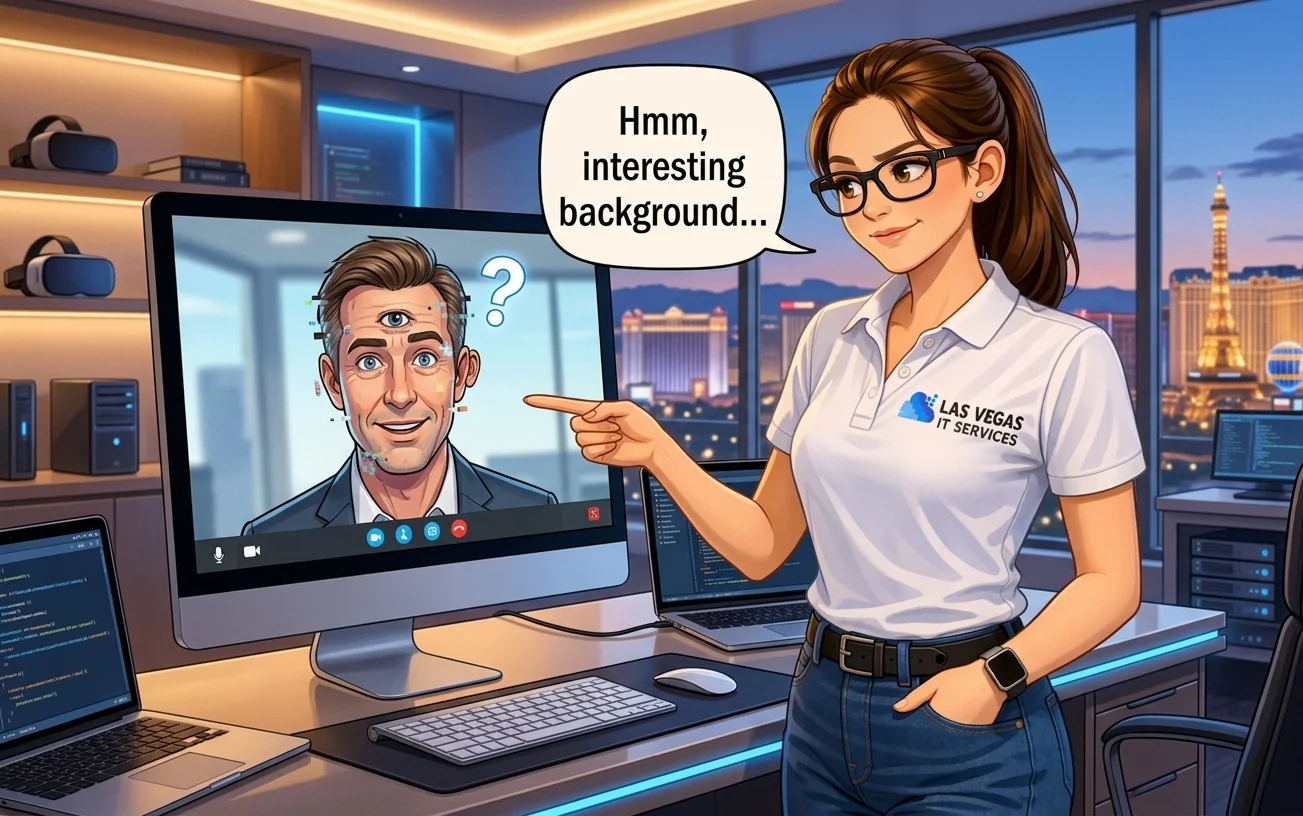
Hiring fraud has changed. It is no longer limited to fake resumes, inflated credentials, or stolen references. Businesses are now dealing with candidates who use AI-generated video, voice, and identity details to appear legitimate during remote interviews.
For small and midsize businesses in Las Vegas, that creates a real operational risk. A bad hire can expose internal systems, customer data, financial workflows, and privileged conversations before anyone realizes the person on the screen was not who they claimed to be.
This is where deepfake hiring fraud moves from a strange headline to a business problem.
What does deepfake hiring fraud look like?
Deepfake hiring fraud usually starts with a convincing candidate profile. The resume may look polished. The LinkedIn presence may appear complete. The interview may feel normal at first.
The problem is that parts of the candidate identity may be fabricated or manipulated with AI.
That can include:
- a generated or altered face during a video interview
- a cloned voice used during calls
- fake employment history built from scraped public information
- stolen or synthetic identity details used to pass early screening
- an applicant trying to gain access to systems rather than perform legitimate work
The goal is not always a paycheck. In some cases, the real objective is access.
Why does this matter for small businesses?
Large enterprises may have dedicated security teams, formal identity-verification workflows, and mature hiring controls. Many smaller organizations do not.
That gap matters.
A fraudulent hire can create risk quickly:
- exposure of email, file shares, and internal documentation
- access to customer records or financial systems
- malware delivery through approved devices or accounts
- reputational damage if customer or employee data is mishandled
- wasted time and payroll costs during investigation and recovery
If your company hires remotely, uses contractors, or moves quickly to fill specialized roles, your process needs to assume that identity fraud is possible.
Common Warning Signs During Interviews
Deepfakes are getting better, but they are not invisible. Hiring teams should know what to watch for during screening and live interviews.
Video anomalies
Look for visual behavior that feels inconsistent with a normal webcam call:
- facial edges that blur or distort when the person moves
- lip movement that does not quite match speech
- lighting that does not match the background
- unusual eye focus or a fixed stare into the camera
- repeated expressions or limited natural movement
Any one of these issues can happen in a normal call. The concern is a pattern that stays noticeable throughout the interview.
Audio inconsistencies
Pay attention to voice quality and timing:
- slight delay between response and speech
- tone that sounds flattened or synthetic
- abrupt changes in cadence or pronunciation
- background noise that cuts in and out unnaturally
These clues are subtle, which is why interviewers should document them rather than rely on memory afterward.
Evasive verification behavior
Fraud becomes more likely when a candidate avoids normal validation steps.
Examples include:
- reluctance to join a live video call with cameras on
- refusal to complete a second interview with a different team member
- excuses that block screen sharing or live skill demonstrations
- resistance to standard identity or employment verification
Practical Controls That Reduce Risk
Most companies do not need exotic tooling to improve here. They need a more deliberate process.
Start with the basics:
- Require at least one live video interview with a second interviewer present.
- Ask candidates to answer a few unscripted follow-up questions tied to their actual work history.
- Use live skill demonstrations for technical or access-sensitive roles.
- Verify identity before granting access to email, shared drives, CRM platforms, or internal messaging tools.
- Separate hiring approval from account provisioning so one rushed decision does not create immediate access.
A few supporting security practices also help:
- enforce MFA on every business system
- limit default privileges for new users
- log early account activity for new hires and contractors
- review onboarding access by role instead of convenience
These are the same kinds of layered controls that strengthen day-to-day operations across a broader cybersecurity program.
Where do managed IT and security teams help?
Many business owners do not need a lecture on AI. They need a hiring process that will not open the door to the wrong person.
That is where process, identity controls, endpoint management, and access policy all intersect. If your team is hiring remotely or scaling quickly, this is worth reviewing alongside your broader security posture.
For companies that need help tightening access and onboarding controls, managed IT services in Las Vegas can help standardize MFA, device setup, user provisioning, and audit visibility. If you are reviewing broader operational gaps, our cybersecurity checklist for Las Vegas small businesses is a useful companion resource.
Final Takeaway
Deepfake hiring fraud is not a reason to panic, but it is a reason to modernize your hiring controls.
If your process assumes that a polished resume and a clean video interview are enough, that assumption is now outdated. A better approach is simple: verify identity deliberately, separate hiring from access, and treat onboarding as part of cybersecurity rather than only HR.
That shift will do more than reduce hiring fraud. It will make the rest of your business harder to exploit.