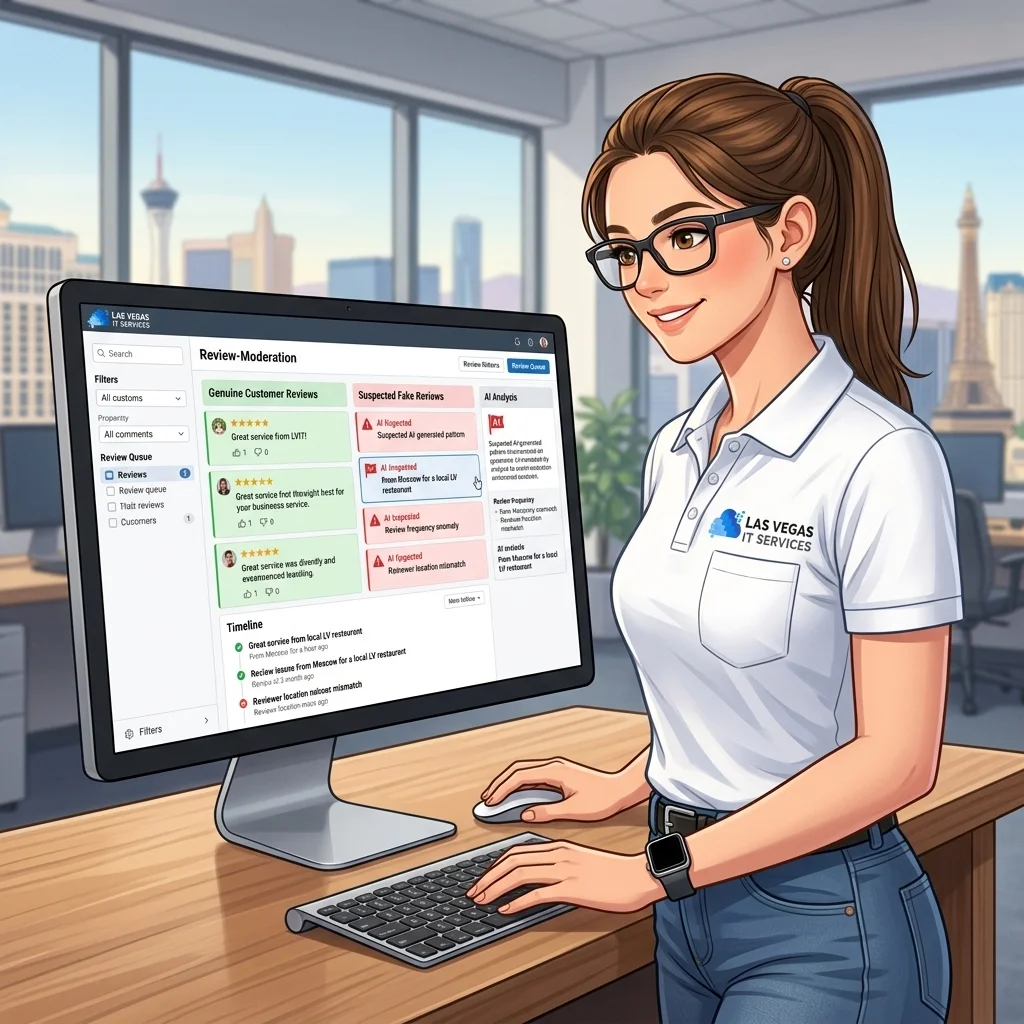
A single fake review usually will not sink a business. Thirty of them, posted in the same week by accounts with no history, will. If you own or run a Las Vegas or Henderson business, your reputation on Google, Yelp, Facebook, and the Better Business Bureau is quietly one of your most valuable assets — and one of the easiest for a competitor, a disgruntled former employee, or an offshore review mill to damage.
The good news: the legal landscape shifted in 2024, and AI-powered review-analysis tools have gotten genuinely useful. The Federal Trade Commission finalized a rule banning fake reviews and testimonials in August of that year, giving businesses real recourse against review fraud for the first time. This guide walks through how to spot faux reviews before they do damage, which AI tools are worth using, and what to do when you find them.
Key takeaways
- Fake reviews are both a marketing problem and a compliance problem — the FTC can now fine bad actors up to roughly $50,000 per violation.
- Most faux reviews follow recognizable patterns: burst timing, generic language, reviewer accounts with no history, and oddly specific product names dropped into unrelated reviews.
- Modern AI review-analysis tools score each review against these signals at a speed and volume no human can match.
- Reporting fake reviews to the platform, and documenting everything, is what actually gets them removed.
- Your response to real negative reviews shapes how new customers judge your business far more than the bad reviews themselves.
Why fake reviews hurt Las Vegas businesses specifically
The Las Vegas market has two features that make fake reviews unusually damaging. First, the volume of visitors and one-time customers means locals and tourists both rely heavily on star ratings — a drop from 4.6 to 4.1 stars moves real money. Second, the service-heavy mix of restaurants, contractors, medical practices, law firms, and retail means most buying decisions start on Google Maps or Yelp, not a website.
A 2024 study cited by the FTC in its rulemaking estimated that a one-star improvement on Yelp correlates with a 5–9% revenue increase for the average local restaurant. Flip that number: a sustained fake-review attack that knocks you from 4.5 to 3.5 can quietly erase a year of growth.
Red flags that AI tools look for
Review-detection models are trained on millions of labeled examples, but the signals they pull out are the same ones you can learn to see yourself. The most reliable indicators:
- Burst timing. Ten negative reviews in 72 hours, after months of steady 4–5 star feedback, almost always means a coordinated push.
- Reviewer history. A profile with one review ever, or one that has reviewed fifty unrelated businesses in three states in a month, is suspicious.
- Linguistic fingerprint. Generic phrases ("terrible service, would not recommend"), no specifics about what actually happened, unusual product-name insertions, or obvious translation artifacts.
- Cross-site echoes. The same review text — or near-identical wording — appearing on Google, Yelp, and the BBB within days of each other.
- Geography mismatch. Reviewers clustered in regions you do not serve, or a sudden wave of out-of-country accounts.
No single signal proves anything. A real angry customer can write a generic one-star review, and new Google accounts are created every day. The value of AI tooling is in weighing the signals together at scale.
AI tools worth considering
You do not need enterprise-grade software to start. Several categories of tool are now accessible to small businesses:
- Review-monitoring platforms (Birdeye, Podium, Reputation.com, Grade.us) ingest reviews from every major platform and flag anomalies. Most include AI sentiment scoring and alerting.
- Generative AI for analysis — feeding a set of suspicious reviews into ChatGPT, Claude, or an in-house model with a clear prompt will quickly surface pattern overlap, shared phrasing, and inconsistent detail. Useful as a second opinion, not a sole source of truth.
- Native platform tools. Google's review moderation and Yelp's Not Recommended filter both use machine learning on the back end. They are imperfect, but filing takedown requests against reviews the platform already flagged internally has a much higher success rate.
- Specialist services such as Signal (by Merchant Fraud Journal), Fakespot (now owned by Mozilla, focused on product reviews), and a handful of reputation management firms that will handle documentation and platform filings for you.
For our small-business IT clients in Las Vegas, we typically set up a review-monitoring dashboard as part of the initial engagement — it takes an hour, and we would rather know about a review surge the morning it starts than six weeks later when the star rating has already dropped.
What to do when you find faux reviews
Catching a fake review is step one. Getting it removed is step two, and the process is more procedural than most business owners expect:
- Screenshot everything immediately. Capture the review, the reviewer profile, and the review history. Platforms sometimes delete reviewer accounts in the middle of a dispute.
- File a platform report. Google, Yelp, Facebook, and the BBB each have review-dispute forms. Cite specific policy violations — impersonation, off-topic, conflict of interest — not just "this is fake."
- Respond publicly, once, and calmly. A short, factual public reply signals to real customers that the review is disputed. Do not argue.
- Preserve evidence of coordination. If reviews are part of a burst, include screenshots of the full set in your report. Platforms are far more likely to act on a pattern than a single review.
- Escalate when the loss is material. If the fake-review attack is demonstrably causing lost revenue, the FTC's final rule gives you standing to report the activity, and some state attorneys general have begun acting on these reports.
Real negative reviews — from real unhappy customers — deserve a different playbook. Respond fast, acknowledge the issue, offer a path to resolution, and move the conversation off the public thread. That single behavior signals competence to the next customer reading your profile.
FAQ
Can AI tools tell me with certainty that a review is fake? Not quite. They produce probability scores and flag patterns. Final judgment still belongs to a human, and platform decisions belong to the platform. What AI gives you is the ability to monitor hundreds of reviews in the time it used to take to read five.
Is the FTC rule actually being enforced against fake reviews? Yes, though enforcement is targeted at large-scale offenders so far — review brokers, marketing firms that pay for reviews, and businesses that suppress negative feedback through threats. The existence of the rule also matters: it gives platforms a clear basis for removal and gives businesses a clear complaint channel.
Do I need a dedicated marketing firm to manage this, or can my IT provider help? A good managed IT provider can handle the monitoring setup, alerts, and reporting workflow — the same systems-level work that runs your email security and backups. Messaging and response strategy are usually better owned by a marketing firm; we work alongside our clients' marketers when they have them, and handle the review-monitoring plumbing either way. For a deeper look at where AI fits into daily operations today, see our what AI can do for your Las Vegas business post.
Ready to get ahead of review fraud?
If your star rating is quietly drifting, or if you have simply never had real visibility into what is being said about your business online, we can get a Las Vegas-grade review-monitoring system in place in a single week — alerts, dashboard, and a documented response playbook included.
Get started with an assessment for your Las Vegas business — flat-rate IT, Las Vegas and Henderson based, with clear month-to-month billing.